
Why Small Bay Industrial Properties Continue to Outperform in South Florida
While the large warehouse segment of the industrial market continues to face rising supply and moderating demand, small bay industrial properties remain in short supply. As a result, leasing activity and rent growth in this segment continue to outperform the broader industrial market, especially in South Florida.
Vacancy Rates Rise for Large Warehouses
Industrial properties larger than 50,000 square feet have experienced a noticeable increase in vacancy rates. Vacancy has climbed from approximately 3% in 2023 to more than 6% as of mid-2024.
This increase is largely due to a surge in new supply entering the market. At the same time, leasing activity has returned to pre-pandemic levels, similar to those recorded between 2015 and 2019.
The imbalance between supply and demand has slowed rent growth for larger industrial properties over the past several quarters.
Small Bay Industrial Space Continues to See Strong Rent Growth
In contrast, smaller industrial properties continue to attract strong tenant demand.
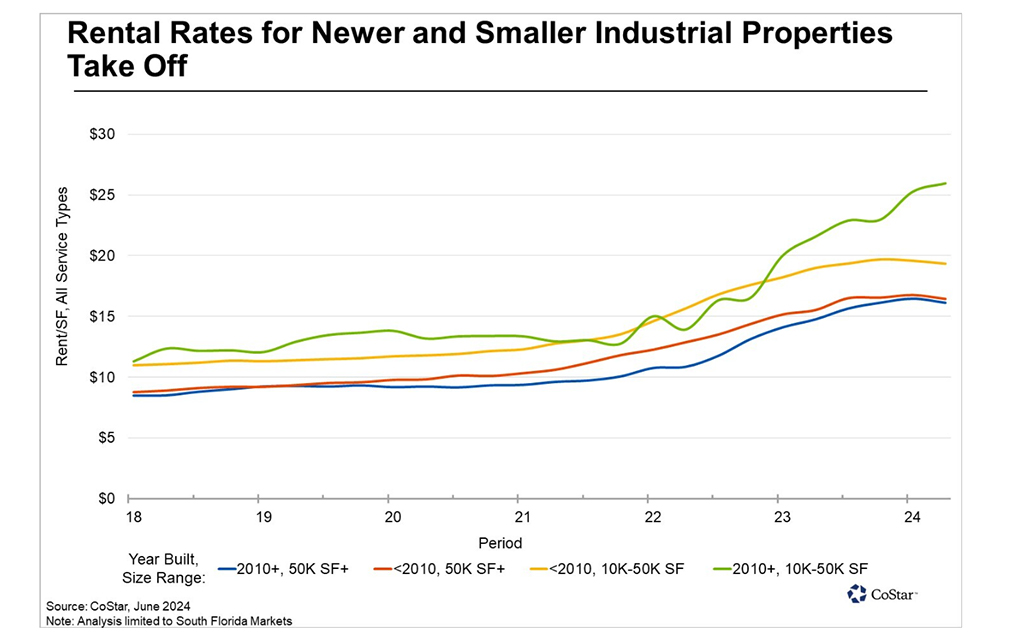
Rent growth for newer small bay properties has outpaced the South Florida market average since 2023. Average asking rents have increased to roughly $25 per square foot, compared with about $21 per square foot a year earlier.
This represents a year-over-year increase of nearly 20%.
Limited new construction and healthy leasing demand have supported these rent gains, making small bay properties one of the strongest-performing industrial asset classes in the region.
Leasing Activity Remains Strong for Smaller Spaces
Smaller industrial spaces continue to lease faster than larger properties.
Available space in buildings ranging from 10,000 to 50,000 square feet typically remains on the market for less than three months before securing a tenant. By comparison, larger industrial spaces—particularly newer developments—often require around nine months to lease.
The number of lease transactions involving newer small bay properties has also increased significantly over the past year. Leasing activity in this segment is approaching its highest level since 2019.
Older small bay properties continue to perform well, maintaining approximately 80% of their peak leasing activity. Meanwhile, larger industrial properties are operating at only 60% to 70% of their peak leasing levels.
Strong Tenant Demand Supports the Small Bay Market
More than 60% of industrial leasing activity in South Florida occurs within properties between 10,000 and 50,000 square feet.
This concentration of demand provides a deep tenant pool for small bay industrial properties. Combined with limited new supply, this demand continues to support rent growth across the sector.
Limited Supply Creates Competitive Advantages
Supply growth remains one of the key advantages for small bay industrial properties.
Since 2019, total small bay inventory in South Florida has increased by less than 1%. During the same period, inventory for larger industrial properties has expanded by more than 35%.
Looking ahead, the supply of newer large industrial facilities is expected to grow by approximately 14% in 2024. In contrast, newer small bay inventory is projected to increase by less than 5%.
Outlook for South Florida Small Bay Industrial Properties
The long-term outlook for the small bay industrial sector remains positive.
When both newer and older properties are considered, total small bay inventory is expected to decline through 2026 as older buildings continue to be demolished. At the same time, tenant demand remains strong across the region.
With limited supply, shrinking inventory, and healthy leasing activity, small bay industrial properties are well-positioned to continue outperforming larger industrial assets in South Florida.
Source: CoStar