
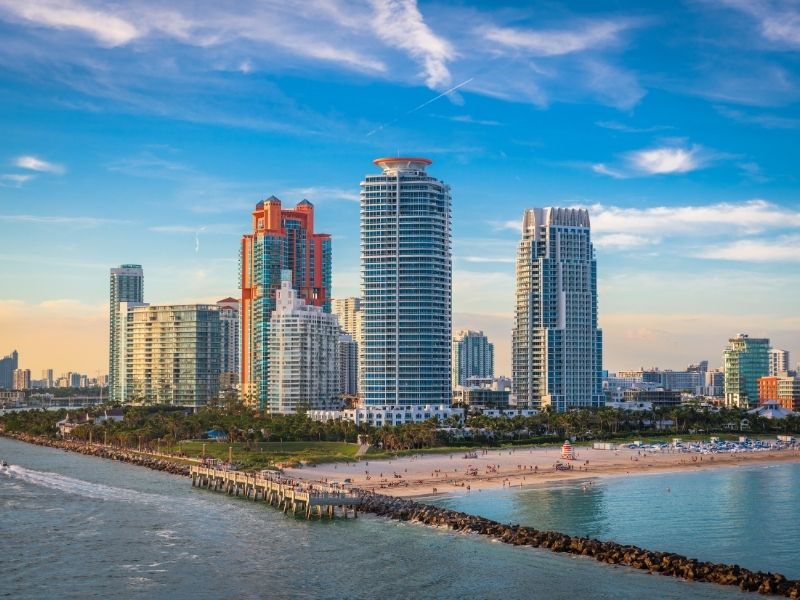
Miami-Dade County has solidified its position as the premier destination for institutional commercial real estate capital in the Southeastern United States. As of March 2026, the market is defined by a significant “flight to quality,” where modern infrastructure and strategic location outweigh simple cost considerations. Total commercial sales in Southeast Florida reached a post-pandemic high of $16 billion recently, with the industrial and office sectors in Miami-Dade leading the surge in both valuation and rental growth.
Navigating this high-velocity environment requires a focus on the two asset classes that continue to outperform national averages: high-spec industrial facilities and trophy office spaces.
Industrial and logistics
Industrial real estate remains the most active and resilient sector in Miami. Following a record-breaking year for sales volume, industrial acquisitions in the region have reached approximately $4 billion, driven by Miami’s role as a global logistics gateway. Average asking rents for industrial space have stabilized at a historic high of $16.28 to $16.40 per square foot (NNN), reflecting a 3.3% increase year-over-year.
The demand is currently bifurcated. While the overall vacancy rate stands at 5.2% to 6.9% due to a surge in new deliveries (3.9 million square feet in the last cycle), Class A “big-box” and “last-mile” facilities are being absorbed at a measured but steady pace. Submarkets like Airport West, Medley, and the I-75 Corridor are the primary targets for institutional investors. These occupiers are specifically seeking facilities with 32’+ clear heights and heavy power infrastructure capable of supporting the automation and robotics that define 2026 logistics.
See our available properties here.
Trophy and class A office
While many U.S. cities face office contraction, Miami continues to be the national outlier. The “Brickell effect” has expanded into Downtown Miami and Coral Gables, where prime Class A assets continue to draw high-net-worth corporate tenants and global finance firms. Full-service asking rental rates for Miami office space reached an all-time high of $61.49 to $66.87 per square foot at the start of 2026.
There is a huge divide in the office sector between “trophy” properties and the secondary market for office space today. As we are witnessing over 60% of all leasing activity at present concentrated on Class A (less than 10% of total) in the current year, this is the largest percentage of leasing activity in the last 10 years.
Many tenants are moving out of older buildings with fewer amenities into newly built properties with LEED certification, wellness amenities, and modern professional office infrastructure. Recent changes to Florida’s commercial leasing and taxation laws have contributed to high levels of confidence, which should support growth in occupancy by absorbing the 1,300,000 square feet of current construction.
Specialized Industrial: Cold storage and data centers
A burgeoning sub-sector within the Miami industrial market is the rise of specialized facilities, particularly cold storage and data centers. Driven by the evolution of global food supply chains and the massive processing requirements of AI, these assets are commanding significant rental premiums. In Miami, cold storage space is particularly scarce, leading to aggressive pre-leasing of new projects.
Institutional capital is increasingly targeting these “specialized” industrial assets because they offer higher barriers to entry and long-term tenant stickiness. As Miami continues to grow as a tech and trade hub, the need for data centers and climate-controlled logistics near the urban core is expected to be a primary driver of investment volume throughout the remainder of 2026.
You might be interested in: Leasing vs. buying industrial property: Miami guide
Strategic investment outlook for 2026
Investors who are disciplined will be rewarded in today’s market cycle. Meanwhile, liquidity is coming back into the Miami market as mortgage rates will likely remain stable between 5.25% and 5.75%, the first time since 2022.
Ownership of any commercial property is no longer a surefire way to succeed; winners will be those focusing on the quality of their potential assets and the functional value of these properties.
If you found our article useful, please share it with others and don’t forget to follow us on Facebook, Instagram and LinkedIn as well as check out our services at agorare.com