
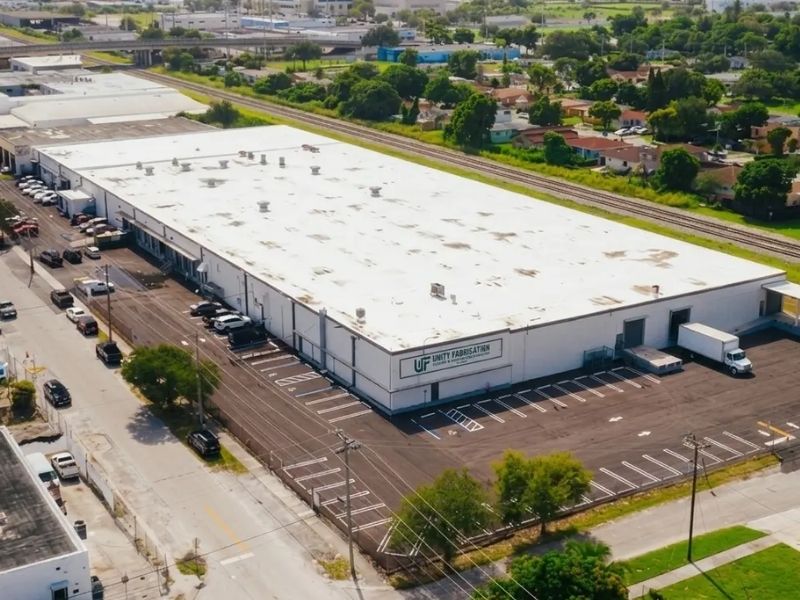
Right now, industrial vacancy rates across Miami-Dade County hover between 6.8% and 8.0%. On paper, it looks like the market is finally finding its balance after years of heavy growth. In this South Florida industrial market report, we’ll look at why relying purely on countywide percentages doesn’t give you the full picture. Broad averages hide what is actually happening on the ground in mature, inner-city corridors. While newer developments out on the suburban fringes see more space open up, dense urban areas face a completely different set of competitive pressures.
Central Miami is a clear example. Because it sits right in the middle of everything, it serves as a critical logistics hub for businesses that absolutely need to be close to downtown, dense customer bases, and major transit hubs across air, land, and sea.
Key Central Miami submarket metrics
On the ground, Central Miami operates exactly like you’d expect a fully built-out area to run—space is limited, and competition is steady. Instead of guessing how the market is performing, look at the actual numbers from Agora Real Estate Group to see what is really happening here:
- Total space available: Central Miami is a relatively small, compact hub with just 3.5 million square feet of total warehouse space. It’s a tight, specialized pocket compared to the massive industrial corridors popping up elsewhere.
- Vacancy rates: The vacancy rate here sits at a remarkably low 3.5% and keeps dropping. This is way lower than the rest of the county, proving that businesses are holding onto their spaces and demand for central locations isn’t slowing down.
- Net absorption: Over the past year, net absorption held steady at 48.1 thousand square feet. This number shows a consistent market where spaces get filled quickly and tenants prefer to stay put.
- New construction: There are currently 0 square feet under construction. Because the area is already completely built out, there is simply no empty land left to develop. This lack of new inventory protects current property values because landlords don’t have to worry about an oversupply of new buildings driving prices down.
- Rents and purchase prices: Because spaces are hard to come by, average market rents have climbed to $20.19 per square foot NNN. Property values follow the same path, with average purchase prices rising to $269 per square foot.
See more submarket data on our website.
Technical specifications of LINK Sunshine State
Located within the 1300–1350 NW 74th Street block, LINK Sunshine State is an example of an existing warehouse facility right inside the Central Miami perimeter. Under institutional ownership and management, the property features a physical layout built for regional distribution and light industrial properties uses:
- Total available space: ±100,453 square feet of infill industrial space.
- Dedicated office area: ±5,500 square feet of built-out office space for administrative management.
- Clear ceiling height: 16 feet and 8 inches of clear vertical workspace. This is lower than newer suburban builds, which is typical for legacy infill properties.
- Loading configuration: Equipped with 16 dock-high loading positions and 2 additional external loading docks.
- Ramp access: 2 durable concrete ramps providing direct drive-in access to the warehouse floor.
- Construction type: Built utilizing solid concrete tilt-up construction parameters.
- Security & storage: Features a fully fenced parking and loading area, paired with outdoor storage capabilities.
Location and access
Location dictates how a logistics operation functions, and being right off the highway is a defining feature here. LINK Sunshine State sits directly along I-95, right at the NW 79th Street exit. For drivers, that means no wasting time crawling through local traffic lights or dragging heavy trucks down slow neighborhood roads. They can get on the interstate immediately.
For a business that relies on quick local deliveries across Miami, this central access is an important asset. It puts inventory just minutes away from the airport’s main cargo gates, PortMiami, and the rest of the city’s commercial hubs. Shorter routes mean drivers spend less time stuck in traffic, burn less fuel, and daily transport costs stay under control.
You might also be interested in: Bridge Point AVE | Miami Lakes, FL
Navigating dense, supply-constrained infill corridors
The real estate environment in Central Miami clearly shows how land limits shape local distribution networks. While outer suburban corridors navigate a wave of new inventory completions, mature inner-ring submarkets stay insulated due to a fundamental lack of land to build new structures.
Success for businesses operating within these dense corridors comes down to using existing, strategically located buildings that reduce drive times. By running operations within a mature urban perimeter, companies gain immediate access to reliable customer bases, transit networks, and established local labor pools, ensuring long-term consistency across the South Florida landscape.
Track the South Florida industrial market with Agora
Evaluating the statistical differences between localized Miami submarkets requires real-time data and deeply rooted regional insight. The professional team at Agora Real Estate Group actively tracks the shifting patterns of vacancy, pricing, and absorption across every logistics corridor in South Florida.
To review detailed submarket reports, browse active infill listings, or evaluate tailored real estate strategies for your business, visit our comprehensive database at agorare.com.