
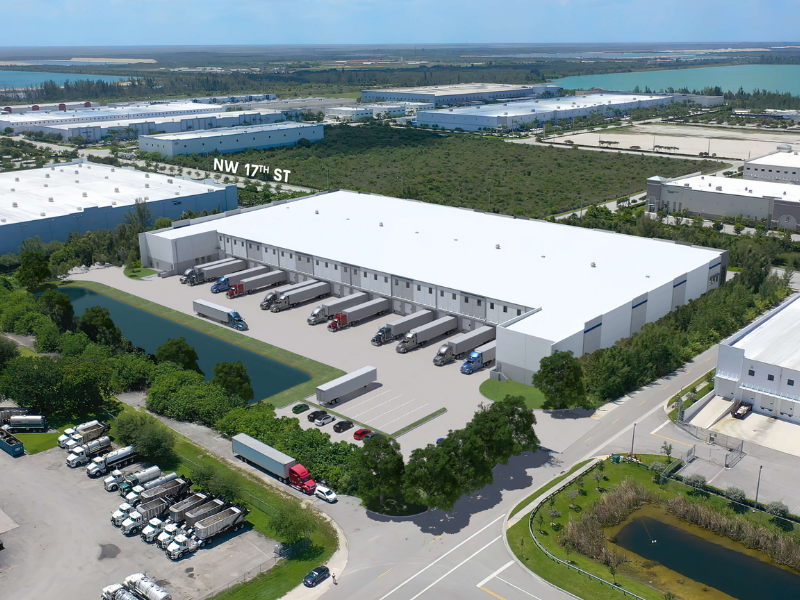
Navigating an industrial property investment strategy in South Florida during 2026 requires balancing steady underlying demand. At the same time, you must consider a maturing, highly selective commercial real estate market. Driven by international trade at PortMiami and Miami International Airport, nearshoring expansion from Latin America, and sustained population influx, South Florida remains one of the country’s most resilient industrial hubs.
While the aggressive rate of rent growth seen in recent years has normalised into a healthier, more predictable pace, disciplined investors can still identify high-yielding asset classes. In addition, there are strategic submarkets across the region.
South Florida industrial market performance: Q2 2026 fundamentals
Analyzing performance data from the Agora Real Estate Group Q2 2026 Market Report reveals an industrial market shifting toward stabilization and sustainable long-term metrics:
- Countywide vacancy rate: Vacancy in Miami-Dade County reached 8.0% in Q2 2026, up from 6.7% a year prior. This adjustment reflects the arrival of new construction deliveries alongside localized tenant rightsizing, while remaining disciplined compared to national commercial averages.
- Average asking rental rates: The average market rent sits at +/- $20.75 per square foot NNN. Rent growth has moderated to an annual rate of +/- 1.5%, signaling a market where landlords are providing competitive terms to retain high-credit tenants.
- Market sale prices: Valuations remain strong across the region, with average market sale prices holding steady at +/- $204 per square foot. Buyers are prioritizing assets with established cash flow and submarket-specific growth potential.
- Under construction pipeline: Approximately 3.9 million square feet of industrial space is currently under construction across Miami-Dade. While this pipeline adds near-term supply, strict zoning and high land costs ensure long-term inventory scarcity.
- Macroeconomic foundations: Miami’s broader economy supports this industrial baseline. The metropolitan statistical area encompasses roughly 2.83 million residents and 1.3 million jobs, with local economic growth advancing at +/- 3.3% annually and total employment rising by +/- 1.3%.
Top submarkets for Miami industrial real estate capital
Identifying prime deployment opportunities within Miami industrial real estate requires evaluating localized supply dynamics, transportation access, and tenant profiles across key submarkets.
Doral and Airport West
- Strategic role: As the premier international air-cargo and freight forwarding hub in South Florida, Doral and Airport West sit directly adjacent to Miami International Airport and major expressways (SR-836 and SR-826).
- Market dynamics: Doral commands premium asking rents, frequently exceeding +/- $22.00 to $24.00 PSF NNN for modern logistics space. High institutional ownership and limited developable parcels make acquisitions highly competitive.
- Investor focus: Best suited for institutional capital seeking stabilized Class A logistics facilities, cold storage hubs, and corporate headquarters facilities tied to Latin American trade routes.
Medley and Hialeah infill corridors
- Strategic role: Medley industrial real estate and Hialeah represent the industrial engine of Miami-Dade County, featuring extensive rail connectivity, heavy industrial zoning, and direct access to a dense labor base.
- Market dynamics: Hialeah industrial real estate consistently maintains tight vacancy rates (often holding between 5.0% and 5.5%), driven by relentless tenant demand for manufacturing, assembly, and trade distribution space.
- Investor focus: Highly attractive for private investors and regional funds seeking value-add acquisitions, building upgrades, and multi-tenant small-bay parks that generate durable cash flows.
Opa-locka and North Miami
- Strategic role: Opa-locka has evolved into a vital distribution center due to its proximity to Opa-locka Executive Airport, Gratigny Parkway, and I-95.
- Market dynamics: Featuring newer Class A industrial parks, Opa-locka accommodates large-footprint e-commerce fulfillment and regional fulfillment operations. Rents average around $18.00 to $20.00 PSF NNN.
- Investor focus: Ideal for mid-to-large-scale investors targeting modern, high-cube warehouses with multi-dock configurations and ample truck staging.
South Dade Growth Sector
- Strategic role: Encompassing Homestead and South Dixie Highway corridors, South Dade is capturing last-mile service providers following rapid residential population expansion in southern Miami-Dade.
- Market dynamics: Characterized by extremely limited industrial inventory, South Dade records low submarket vacancy rates and robust pricing resilience.
- Investor focus: Well-suited for last-mile logistics facilities, contractor yards, and localized service bays catering to household demand.
You might be interested in: Industrial investment in Miami: Opportunities for investors
High-performing asset types for industrial real estate investing
Executing a successful industrial real estate investing plan in 2026 involves matching specific building configurations with tenant demand trends.
Small-bay flex properties
Small-bay industrial properties—typically featuring units between 1,500 and 10,000 square feet—offer outstanding risk-adjusted yields in South Florida. This is because high land costs discourage developers from constructing small-bay projects. As a result, supply remains constrained. Moreover, demand from local trade contractors, light fabricators, e-commerce vendors, and service businesses creates high tenant retention and granular income diversification.
Last-mile distribution centers
Urban infill facilities located within a 20-minute drive of major consumer concentrations remain essential for third-party logistics (3PL) providers. They are also crucial for grocery distributors and e-commerce platforms. Key property characteristics that command rent premiums include 30’+ clear heights, abundant dock-high doors, wide truck courts, and dedicated trailer parking.
Cold storage and food processing assets
Miami’s position as a primary entry point for perishable goods from Central and South America drives demand for temperature-controlled facilities. Cold storage assets carry higher capital investment requirements. However, they yield longer lease terms (often 10–15 years). Significantly higher rental rates also result compared to standard dry storage facilities.
Sustainable and energy-efficient warehouses
Rising utility overhead and corporate sustainability mandates make energy-efficient warehouses increasingly competitive. Buildings featuring solar-ready roofing, high-efficiency LED lighting, upgraded insulation, and EV charging infrastructure experience lower vacancy downtime. Furthermore, they command tenant retention premiums across South Florida.
Risk management and underwriting considerations for 2026
Capital deployment in South Florida industrial assets requires careful evaluation of operational expense trends. Investors should also assess deal structures:
- Property insurance and tax underwriting: Insurance rates have stabilized following Florida legislative reforms, but property insurance and tax assessments remain significant components of property operating expenses (OpEx). Underwriting models must incorporate conservative expense buffers and verify property tax adjustments post-acquisition.
- Tenant improvement (TI) concessions: As lease negotiations reach equilibrium, landlords are offering targeted tenant improvement allowances for office build-outs and air conditioning upgrades to secure long-term lease commitments rather than discounting base rental rates.
- Supply chain alignment: The continued growth of Latin American trade and nearshoring manufacturing in Mexico positions Miami as a primary commercial and financial hub. Assets equipped to handle intermodal logistics, freight consolidation, and flex-office capabilities are best positioned to capture relocating trade firms.
Working alongside experienced market specialists, such as Agora Real Estate Group, allows investors to access off-market deal flow and evaluate real-time leasing transactions. In addition, they can analyse targeted submarkets across South Florida.
Frequently Asked Questions
What are average industrial cap rates in Miami-Dade County for 2026?
Stabilized Class A logistics assets in primary submarkets like Doral trade at cap rates between 5.25% and 5.75%. Value-add opportunities or Class B/C small-bay properties in infill submarkets typically trade at cap rates between 6.00% and 6.50%, accounting for localized management requirements and capital improvement plans.
Why is small-bay industrial space in high demand across South Florida?
Small-bay industrial space benefits from structural supply constraints. This is because high land and construction costs make new small-bay development economically impractical for many builders. Consequently, steady demand from regional service providers, contractors, and small businesses keeps vacancy rates low. As a result, landlord pricing power remains strong.
How does nearshoring impact Miami industrial real estate performance?
As manufacturing shifts closer to North America via Mexico and Latin America, South Florida serves as the central administrative, freight, and trade consolidation hub for the region. This macroeconomic trend increases demand for logistics warehouses, air-cargo facilities, and corporate office-warehouse flex spaces throughout Miami-Dade.
What should investors monitor regarding operating expenses in 2026?
Investors should closely analyze real estate tax reassessments following property transfers and review property insurance policies. Accounting for accurate Triple Net (NNN) expense pass-throughs ensures clear expense projections and protects net operating income (NOI).
Capitalize on South Florida industrial opportunities with Agora Real Estate Group
South Florida’s industrial market continues to offer premier capital growth and income potential for commercial real estate investors. Capitalising on top-tier assets requires local market experience, rigorous underwriting, and deep industry networks.
Whether you are looking to acquire a multi-tenant flex facility, reposition an infill warehouse, or expand a logistics portfolio, Agora Real Estate Group provides commercial brokerage, asset management, and advisory services tailored to your objectives. Review our latest market research via our Q2 2026 Market Report or contact Agora Real Estate Group today to discuss your investment goals.