
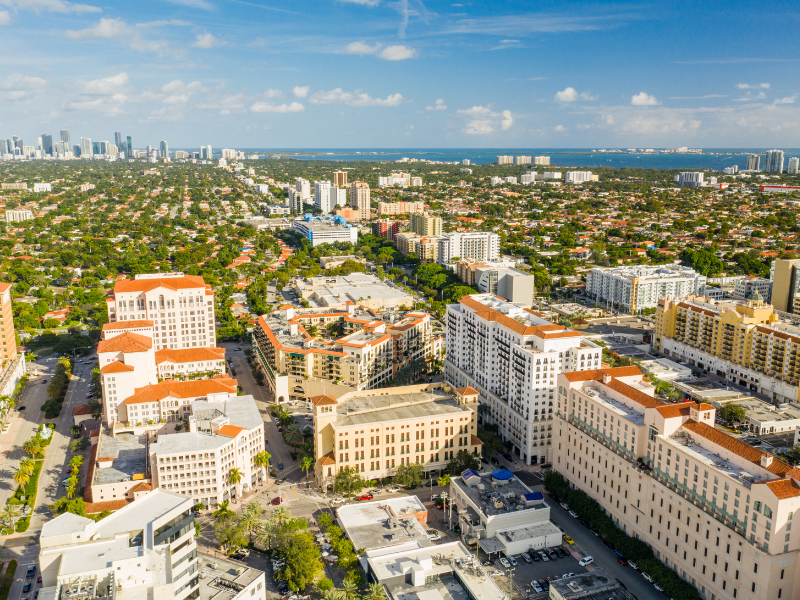
Analyzing the growth of commercial real estate in South Florida reveals a significant shift away from traditional industrial hubs. As land availability decreases and occupancy costs climb in northern submarkets like Doral and Medley, the South Dixie Highway industrial submarket has emerged as an essential operational corridor for logistics, trade services, and last-mile distribution across Miami-Dade County.
This corridor stretches along US-1 (South Dixie Highway) and the Homestead Extension of Florida’s Turnpike (HEFT). Historically viewed as a localized service area, South Dixie Hwy now operates as a high-demand industrial node. This educational guide breaks down localized Q2 2026 performance metrics from Agora Real Estate Group, examines core macroeconomic drivers, evaluates dominant property types, and provides actionable guidance for business owners, landlords, tenants, and commercial real estate investors.
South Dixie Highway performance metrics and benchmarks
Evaluating real estate along South Dixie Hwy requires comparing localized performance indicators against broader Miami-Dade County trends. While countywide vacancy rates have adjusted upward due to speculative construction completions in central and northern corridors, South Dixie Hwy maintains exceptionally tight operational fundamentals.
Localized performance metrics
- Total submarket inventory: +/- 11.7 million square feet of industrial, commercial, and flex space.
- Submarket vacancy rate: +/- 2.4%, representing one of the lowest industrial vacancy rates across South Florida.
- Average asking rent (NNN): +/- $22.32 per square foot Triple-Net, reflecting steady rent growth driven by severe inventory scarcity.
- Average market sale price: +/- $289 per square foot, outperforming countywide price baselines due to high buyer competition for infill assets.
Comparison with surrounding Miami-Dade submarkets
To put these metrics into perspective, broader Miami-Dade County industrial inventory totals approximately 285 million square feet, with an overall vacancy rate hovering around 8.0%. Countywide asking rents average +/- $20.75 per square foot NNN, while market sale prices average +/- $204 per square foot across all asset classes.
Submarkets experiencing heavy pipeline deliveries display much higher vacancy levels:
- Medley: 41.7 million SF inventory | 9.4% vacancy rate | $19.43/SF NNN asking rent.
- Miami Airport West: 64.9 million SF inventory | 8.8% vacancy rate | $23.37/SF NNN asking rent.
- Hialeah: 45.6 million SF inventory | 5.1% vacancy rate | $17.35/SF NNN asking rent.
- Miami Lakes: 12.8 million SF inventory | 7.5% vacancy rate | $19.18/SF NNN asking rent.
While submarkets like Doral, Medley, and Opa-locka absorb large volumes of new construction, South Dixie Hwy operates under tight supply constraints. With just 11.7 million square feet of total space and a 2.4% vacancy rate, available inventory is absorbed rapidly, providing landlords with strong pricing power.
You might be interested in: Gateway South Dade: Class A industrial park analysis
Core economic drivers in southern Miami-Dade
The strength of the South Dixie Highway industrial submarket is backed by fundamental economic, demographic, and geographic drivers that set southern Miami-Dade apart from central industrial zones.
Demographic density and supply mismatch
South Dade accounts for more than 54% of Miami-Dade County’s 2.83 million residents. Despite housing over half of the county’s population, South Dade historically contained less than 3% of its modern warehouse inventory. This disparity created severe supply chain friction.
Distributors, e-commerce platforms, and home service providers serving communities in South Miami, Palmetto Bay, Cutler Bay, and Homestead previously had to dispatch vehicles from central facilities in Doral or Hialeah. Establishing operations along South Dixie Hwy resolves this geographical imbalance by positioning goods directly adjacent to high-density consumer populations.
See more up-to-date information on Miami’s industrial market in our Q2 market report.
Physical constraints and high barriers to entry
Unlike northern corridors in Medley or Opa-locka that historically featured agricultural land suitable for large-scale rezoning, the South Dixie Highway industrial submarket is physically constrained. Encapsulated by established residential neighborhoods, commercial retail strips, agricultural preserves, and the Urban Development Boundary (UDB), buildable land is scarce. Because speculative ground-up development cannot expand freely, existing property owners along US-1 benefit from strong protection against oversupply risks, preserving the low 2.4% submarket vacancy rate.
Workforce access and reverse commute mechanics
Sourcing reliable labor remains a top priority for warehouse operators in South Florida. In South Dade, approximately 45% of the local labor force commutes 60 minutes or longer northbound each morning to work in central hubs like Doral, Airport West, or Downtown Miami. Businesses establishing operations along South Dixie Highway gain a major hiring advantage.
By offering jobs locally, employers enable staff to travel southbound in the morning—engaging in a “reverse commute” against peak northbound traffic. This significantly cuts travel times, lowers employee turnover, and improves workforce retention.
Regional transit geometry and Florida Keys access
Situated at the intersection of US-1 and the Homestead Extension of Florida’s Turnpike (HEFT), South Dixie Highway industrial submarket serves as the primary gateway to Monroe County and the Florida Keys.
Regional distributors, food suppliers, and trade contractors based along South Dixie Hwy can service both southern Miami-Dade households and the Florida Keys within a 90-minute drive window, avoiding the heavy traffic congestion associated with central Miami highways like the Palmetto Expressway (SR 826).
Dominant property types and occupier demand
Tenant demand along South Dixie Highway differs noticeably from big-box distribution hubs like Medley or Airport West. Rather than massive 200,000-plus square foot bulk fulfillment centers, this corridor is defined by functional, specialized property types:
- Small-bay and flex facilities: Units ranging from 1,500 to 10,000 square feet form the core of the South Dixie Hwy corridor. These properties accommodate trade contractors, HVAC technicians, electrical suppliers, plumbing specialists, and light manufacturers requiring flexible office-warehouse layouts with street-level loading.
- Last-mile logistics nodes: E-commerce operators and regional logistics providers utilize mid-sized facilities along South Dixie Hwy for same-day and next-day delivery networks. Placing fulfillment nodes in South Dade drastically reduces stem times, fuel consumption, and vehicle wear compared to dispatching fleets from northern submarkets.
- Class A industrial parks: To address the historic shortage of modern logistics infrastructure, new master-planned developments have emerged in Homestead. Facilities such as Gateway South Dade—a 169,000-square-foot Class A development—bring high-specification capabilities to the submarket, including 32-foot clear heights, ESFR fire protection, 185-foot truck courts, and dedicated trailer parking.
Strategic advisory for investors, landlords, and tenants
Navigating commercial real estate along South Dixie Hwy requires tailored strategies depending on whether you are acquiring, leasing, or managing property.
Strategic advice for commercial real estate investors
- Focus on small-bay multi-tenant assets: Given the tight 2.4% vacancy rate, multi-tenant small-bay properties offer low vacancy risk and steady mark-to-market rental growth upon lease renewals.
- Account for steady rental growth: With asking rents averaging $22.32/SF NNN, strong tenant demand supports 4% to 5% annual contractual rent escalations.
- Target long-term capital appreciation: Due to strict land supply limits along US-1, assets in this corridor command premium valuations ($289/SF) relative to countywide baselines ($204/SF), making them suitable for long-term capital preservation.
Operational advice for tenants and business owners
- Start lease negotiations early: Because submarket inventory is limited to 11.7 million square feet, vacant options are absorbed quickly. Tenants should begin evaluating lease renewals or relocation options 9 to 12 months before expiration.
- Evaluate stem-time savings against rent: While NNN rents along South Dixie Hwy ($22.32/SF) sit higher than county averages ($20.75/SF), the operational savings from shorter delivery routes, reduced fuel usage, and lower driver overtime frequently outweigh higher rent costs.
- Verify site access and loading ratios: Business owners operating delivery vans or fleet trucks should inspect turning radiuses, parking availability, and loading configurations, as older infill properties along South Dixie Hwy may feature compact lot layouts.
Frequently Asked Questions
What geographic areas make up the South Dixie Highway industrial submarket?
The submarket includes the commercial and industrial corridors running along US-1 (South Dixie Highway) and Florida’s Turnpike in southern Miami-Dade County, serving communities such as South Miami, Palmetto Bay, Cutler Bay, Homestead, and Florida City.
Why is vacancy along South Dixie Hwy lower than in Doral or Medley?
South Dixie Hwy maintains a +/- 2.4% vacancy rate compared to +/- 9.4% in Medley or +/- 8.8% in Airport West because buildable land is constrained by residential development, agricultural preserves, and the Urban Development Boundary. This supply cap prevents speculative overbuilding.
How do asking rents on South Dixie Hwy compare to Miami-Dade averages?
Average asking rents along South Dixie Hwy stand at +/- $22.32 per square foot NNN, compared to the countywide average of +/- $20.75 per square foot NNN. The premium reflects high demand for scarce infill space near South Dade’s population base.
Are there modern Class A facilities available along South Dixie Hwy?
Yes. While the submarket historically consisted of older small-bay properties, modern master-planned developments like Gateway South Dade in Homestead now offer Class A features, including 32-foot clear heights, ESFR sprinklers, and trailer parking.
Navigating the South Dixie Highway industrial market
The South Dixie Highway industrial submarket represents one of South Florida’s most resilient commercial real estate corridors. As demographic expansion continues to drive consumer demand southward, properties along US-1 and Florida’s Turnpike will remain critical operational assets for logistics providers, service trades, and real estate investors.
At Agora Real Estate Group, our team provides localized market intelligence, site selection services, and transaction advisory across Miami-Dade County. Whether you want to lease warehouse space, acquire an infill industrial property, or evaluate your commercial portfolio, our advisors deliver data-driven guidance to help you reach your goals.
To view current lease and sale opportunities along South Dixie Hwy, access our market research, connect with our advisory team, or explore our detailed submarkets guide.