
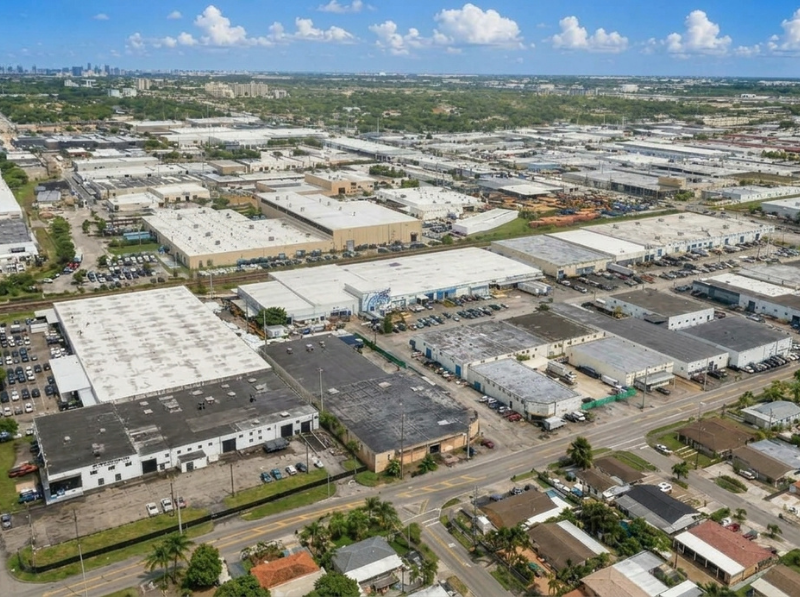
Purchasing Hialeah warehouses for sale represents one of the most reliable and strategic commercial real estate investments in South Florida. Positioned in the industrial heartland of Miami-Dade County, Hialeah has long functioned as a foundational center for manufacturing, trade, and commercial services.
As the broader South Florida commercial market shifts into a period of healthy stabilization, buyers have an exceptional window of opportunity to acquire functional small-bay assets, owner-user facilities, and multi-tenant industrial parks. Navigating this competitive submarket successfully requires a clear understanding of localized pricing benchmarks, municipal zoning requirements, and critical operational features.
What should buyers know before purchasing in Hialeah?
Before purchasing a warehouse in Hialeah, buyers should understand that this submarket offers one of the most cost-effective and low-risk entry points in Miami-Dade County. In our Q3 2026 market analysis, we found that Hialeah maintains an ultra-tight industrial vacancy rate of 5.8% across its 31.5 million square feet of inventory. Average market sale prices benchmark at $229 per square foot, while average direct asking rents sit at $16.14 per square foot.
Compared to broader countywide averages of $281 per square foot for sales and $21.06 per square foot for rent, Hialeah provides buyers with substantial cost savings without sacrificing tenant demand or transport connectivity.
Whether you are an owner-occupier looking to eliminate rental escalations or an investor seeking stable, cash-flowing real estate, Hialeah’s strong labor pool and scarce small-bay inventory ensure high tenant retention and resilient asset values over the long term.
What is the current market value of warehouses for sale in Hialeah?
Evaluating the true value of an industrial property in Hialeah requires placing submarket performance within the context of the larger South Florida commercial ecosystem. While neighboring submarkets like Miami Airport West average $318 per square foot and Miami Airport North averages $288 per square foot, Hialeah provides a far more accessible pricing floor at $229 per square foot. This pricing differential allows buyers to achieve higher initial yields while acquiring functional space in a high-density urban corridor.
The submarket’s 5.8% vacancy rate highlights consistent occupancy, driven primarily by local trade contractors, light manufacturers, and regional distributors. Furthermore, direct asking rents in Hialeah average $16.14 per square foot, offering tenants an affordable operational footprint compared to West Miami’s $28.01 per square foot or Airport West’s $23.59 per square foot. With minimal speculative construction underway—currently under 70,000 square feet—existing property owners remain well-protected from supply gluts that could dilute rental rates or increase vacancy.
To review live property listings and customized submarket reports, explore our Hialeah Industrial Real Estate Guide.
Why are investors and owner-users targeting Hialeah industrial real estate?
Capital continues to flow into Hialeah industrial assets due to several distinct structural advantages that set it apart from other South Florida commercial districts. Chief among these advantages is Hialeah’s unmatched labor density. As one of the most populated municipalities in the state, Hialeah supplies local businesses with a deep, skilled workforce specializing in manufacturing, assembly, HVAC installation, automotive repair, and logistics. For corporate occupiers, operating in Hialeah significantly reduces recruitment costs and minimizes commute times for employees.
Another key factor driving investor interest is the severe scarcity of small-bay industrial product. Over the past decade, institutional developers across Miami-Dade County have focused heavily on constructing large-scale bulk logistics centers exceeding 200,000 square feet. In contrast, Hialeah consists largely of established small-bay multi-tenant parks with unit sizes ranging from 1,500 to 10,000 square feet. Because local service providers and trade contractors constantly require small-bay space, property owners experience low tenant turnover and steady, non-discretionary rental income.
Accessibility also plays a major role in Hialeah’s enduring popularity. The submarket offers direct connections to major regional expressways, including the Palmetto Expressway (SR-826), US-27 (Okeechobee Road), Florida’s Turnpike, and Interstate 75. This well-integrated transportation framework allows logistics operators and distributors to move goods seamlessly between Miami International Airport, PortMiami, and Broward County.
You might be interested in: Industrial Property Investment in Miami: What Investors Should Know
Should you buy, lease, or rent a warehouse in Hialeah?
Determining whether to acquire, lease, or rent industrial property in Hialeah depends on your long-term business goals, balance sheet strength, and operational flexibility requirements.
Buying a warehouse in Hialeah is often the most financially advantageous move for owner-occupiers and long-term investors. Purchasing allows business owners to convert variable rent expenses into fixed mortgage payments while building equity in a supply-constrained commercial market.
With sales prices averaging $229 per square foot, buying in Hialeah requires significantly less capital deployment than acquiring space in Doral or West Miami. For investors, purchasing multi-tenant flex parks yields predictable cash flows and valuable tax benefits through property depreciation.
Leasing commercial warehouse space is the preferred path for expanding companies that want to preserve capital for core business activities, equipment acquisition, or staff expansion. Securing a multi-year lease in Hialeah provides long-term operational stability based on the submarket’s competitive direct asking rate of $16.14 per square foot. Furthermore, leasing allows corporate occupiers to negotiate tenant improvement allowances with landlords to customize space for specific operational needs.
Renting smaller flex or industrial units offers early-stage distributors, trade contractors, and local service providers a low-barrier entry point. Renting allows businesses to establish a functional footprint near dense customer bases without locking up substantial equity in real estate down payments, enabling them to scale into larger spaces as operational demand grows.
What physical and legal features should buyers evaluate during due diligence?
Thorough due diligence is essential to protecting your capital and ensuring a smooth transaction when evaluating industrial properties in Hialeah. One of the first elements to inspect is municipal zoning compliance. Hialeah enforces strict land-use codes, such as M-1 Light Industrial and M-2 Heavy Industrial designations. Buyers must confirm that their planned business operations—or those of their existing tenants—align with local zoning restrictions, outdoor storage allowances, and municipal Certificate of Use mandates.
Physical infrastructure requirements should also be scrutinized. Manufacturing operations, food assembly, and specialized trade services require high-amperage three-phase electrical power, typically ranging from 400 to 2,000+ amps. Additionally, clear ceiling heights of 18 to 24 feet are standard in Hialeah flex facilities, providing essential vertical storage capacity for inventory racking.
Loading configuration is another critical factor influencing long-term functionality. Facilities featuring a versatile mix of street-level drive-in ramps and dock-high loading positions accommodate a wider array of delivery vehicles, making them far more attractive to prospective tenants. Finally, buyers must audit historical property operating expenses, including property taxes, building insurance, and Common Area Maintenance (CAM). Across Miami-Dade County, operating pass-throughs generally range between $4.00 and $7.00 per square foot, making accurate expense verification critical for calculating net operating income.
For broader submarket comparisons, consult our Submarkets Directory.
Frequently asked questions about buying warehouses in Hialeah
What is the average sale price per square foot for warehouses in Hialeah?
According to our Q3 2026 commercial market data, the average sale price for an industrial property in Hialeah stands at $229 per square foot, providing an attractive value compared to the countywide average of $281 per square foot.
What is the current industrial vacancy rate in Hialeah?
Hialeah maintains an ultra-tight industrial vacancy rate of 5.8%, reflecting strong tenant retention, limited new speculative development, and consistent demand from local trade businesses.
What is the average asking rent for warehouse space in Hialeah?
Direct market asking rents in Hialeah average $16.14 per square foot, offering an affordable operational footprint compared to neighboring submarkets like Miami Airport West at $23.59 per square foot.
What types of businesses occupy industrial space in Hialeah?
Hialeah accommodates a highly diverse tenant ecosystem, including light manufacturing, HVAC and plumbing contractors, commercial printing, food processing, building supply wholesalers, and last-mile delivery fleets.
Partner with Agora to buy industrial real estate in Hialeah
Navigating commercial transactions in Hialeah requires deep hyper-local market insight, accurate asset valuation modeling, and proven negotiation capability. At Agora Real Estate Group, we specialize exclusively in South Florida commercial real estate, helping buyers, sellers, and corporate tenants achieve their strategic objectives.
Whether you are searching for an owner-user warehouse, evaluating a multi-tenant investment park, or seeking a comprehensive property valuation, our team provides expert guidance at every step of the process.