
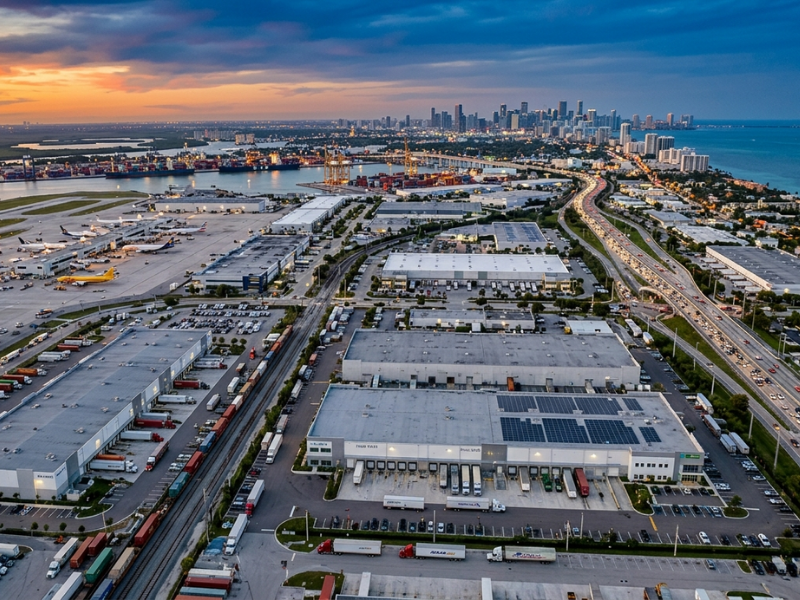
The South Florida commercial real estate landscape has undergone a major evolution over the past decade. It has positioned Miami industrial real estate as one of the most resilient and high-performing institutional asset classes in North America. This shift is driven by robust international trade, severe spatial land constraints, and persistent consumer demand across a growing population. As a result, industrial investment in Miami continues to attract capital from institutional funds, private equity, and family offices in +/- 2026.
Unlike regional markets with unlimited geographic expansion, Miami operates under rigid natural boundaries—bounded by the Atlantic Ocean to the east and the protected Everglades ecosystem to the west. Because of this, permanent land scarcity creates a structural supply floor. This makes industrial property investment in Miami less vulnerable to speculative overbuilding than other major Sunbelt regions.
This educational guide provides an in-depth analysis of current market metrics, core asset classes, submarket variances, and financial mechanics. These factors shape industrial real estate investing across Miami-Dade County.
Current market overview
To evaluate opportunities for industrial investment, investors must examine how Miami-Dade County’s industrial grid functions. This grid covers +/- 180 million square feet of total inventory.
While broader national industrial real estate trends have experienced a period of post-pandemic normalization, Miami continues to maintain exceptionally tight operating metrics. The countywide market exhibits stable baseline performance indicators:
- Total industrial inventory: +/- 180,000,000 SF
- Countywide vacancy rate: +/- 3.8% to +/- 4.5%
- Average asking rent (NNN): +/- $17.50 to +/- $24.00 per SF
- Average operating expenses (CAM): +/- $4.50 to +/- $6.50 per SF
- Baseline capitalization rates: +/- 5.25% to +/- 6.25%
- Active construction pipeline: +/- 3,500,000 SF
See more in the Agora Real Estate Group market reports.
Because new land parcels are extremely limited, market expansion increasingly relies on infill redevelopment, covered land plays, and urban adaptive reuse.
Core growth drivers
Several macro and microeconomic factors converge to sustain long-term demand for industrial real estate investing in South Florida.
1. International trade & air-cargo volume
Miami serves as the primary trade gateway between North America, Latin America, and the Caribbean. Miami International Airport (MIA) consistently ranks among the top airports nationwide for international freight volume. It handles over +/- 2.5 million tons of cargo annually. Similarly, PortMiami’s deep-water berths process upwards of +/- 1.2 million TEUs per year. As a result, industrial facilities positioned near these trade corridors capture steady demand from freight forwarders, logistics operators, and customs brokers.
2. Last-mile fulfillment density
As population density expands across South Florida, consumer expectations for same-day and next-day delivery have intensified. For this reason, fulfilment networks require strategically located last-mile facilities close to major population centres. Infill submarkets like Hialeah, Doral, and South Central Miami allow operators to minimise “stem time”—the unproductive commute time between a distribution warehouse and final delivery points.
3. Supply constraints & barriers to entry
Land development in Miami-Dade County is strictly governed by the Urban Development Boundary (UDB). Available industrial land trades at upwards of +/- £2.5 million to +/- £4.0 million per acre in primary corridors. Therefore, ground-up development carries high financial entry thresholds, protecting existing asset owners from sudden competitive supply surges.
Key asset classes
Investors evaluating industrial investment opportunities in Miami generally categorize assets into three primary operational profiles:
Class A logistics parks
Typically located in master-planned submarkets such as Medley, West Doral, and Hialeah Gardens, Class A facilities offer hyper-modern specifications:
- Clear ceiling heights of +/- 32′ to +/- 36′.
- ESFR sprinkler systems and modern building automation.
- Excess truck court depths of +/- 130′ to +/- 180′ for heavy commercial trailer staging.
- Investment profile: Lower cap rates (+/- 5.0% to +/- 5.5%), backed by long-term institutional leases with corporate credit tenants.
Class B & C infill parks
Situated in established commercial corridors like Airport North, Opa-locka, and South Central Miami, these properties serve small-to-medium enterprises, trade contractors, and regional distributors.
- Clear ceiling heights of +/- 18′ to +/- 24′.
- Flex spaces with modular bay sizes ranging from +/- 2,500 SF to +/- 15,000 SF.
- Mixed loading configurations, including dock-high doors and drive-in ramps.
- Investment profile: Higher initial yield potential (+/- 5.75% to +/- 6.5% cap rates) and strong renewal rates (+/- 80%+). Investors exploring this segment can view active inventory through Agora’s commercial properties for lease.
Industrial Outdoor Storage (IOS)
A rapidly growing niche within industrial property investment, IOS sites feature low building coverage ratios (+/- 10% to +/- 25%) paired with heavy-duty paved yards for equipment storage, fleet parking, and container staging.
- Extreme scarcity within urban core boundaries.
- High rent-per-square-foot yield relative to land area.
- Investment profile: High resilience to obsolescence and minimal ongoing tenant improvement (TI) capital expenditure requirements.
Submarket investment profiles
Understanding micro-market dynamics is essential when allocating capital for industrial real estate investing in Miami-Dade County:
- Airport North (logistics & air cargo hub): Vacancy rates hold at +/- 3.0% to +/- 3.8%, with NNN asking rents between +/- $19.50 and +/- $24.00 per SF.
- Doral (corporate flex & distribution): Maintains a vacancy of +/- 3.5% to +/- 4.2%, commands asking rents from +/- $20.00 to +/- $25.00 per SF NNN, and benefits from proximity to key highway interchanges.
- Medley (heavy industrial & manufacturing): Features a vacancy rate of +/- 4.2% to +/- 5.0% and NNN asking rents ranging from +/- $17.00 to +/- $20.00 per SF, catering to heavy equipment, processing, and assembly.
- South Central Miami (last-mile infill logistics): Exhibits vacancy between +/- 4.8% and +/- 5.5%, asking rents from +/- $18.00 to +/- $21.00 per SF NNN, and virtually +/- 0 square feet of speculative land available for expansion.
- Opa-locka (value-add flex & light industrial): Operates with a vacancy range of +/- 4.0% to +/- 4.8% and asking rents of +/- $17.50 to +/- $21.00 per SF NNN, providing opportunities for value-add repositioning.
You can learn more about local performance metrics via Agora’s South Central Miami submarket overview.
Financial mechanics & risk factors
While the fundamentals of industrial investment in Miami remain strong, investors must navigate specific regional operating dynamics to underwrite deals accurately.
1. Triple-net (NNN) dynamics & CAM
Industrial leases in South Florida operate on a triple-Net basis, where tenants absorb property taxes, building insurance, and common area maintenance.
- Insurance adjustments: Commercial property insurance across coastal Florida has seen significant adjustments in recent cycles. Typical CAM expenses currently average between +/- $4.50 and +/- $6.50 per square foot across Miami-Dade.
- Underwriting tip: Investors should verify historic loss run reports and structural windstorm compliance when acquiring legacy properties.
2. Lease duration & mark-to-market potential
Many legacy multi-tenant parks feature in-place leases signed +/- 3 to +/- 5 years ago that sit noticeably below current market rates. Acquiring assets with short remaining lease terms (Weighted Average Lease Term under +/- 3.0 years) allows investors to execute a “mark-to-market” strategy upon renewal.
3. Debt financing environment
Interest rate shifts directly influence leveraged yield expectations. With baseline cap rates settling between +/- 5.25% and +/- 6.25% for prime assets, investors frequently utilize moderate leverage (+/- 55% to +/- 65% loan-to-value) to preserve positive cash flow spread.
Frequently Asked Questions (FAQ)
What makes Miami industrial real estate unique compared to other US markets?
Miami is geographically constrained between the Atlantic Ocean and the Everglades, creating a natural barrier to land expansion. Combined with high trade volume through PortMiami and Miami International Airport, this land scarcity maintains tight vacancy rates (typically +/- 3.8% to +/- 4.5%). It also supports strong rental growth.
What capitalization rates can investors expect for industrial property investment in Miami?
Baseline cap rates in Miami vary by asset class. Prime Class A institutional logistics facilities trade within the +/- 5.0% to +/- 5.5% cap rate range. Meanwhile, infill Class B multi-tenant parks and value-add assets trade between +/- 5.75% and +/- 6.50%.
How do operating expenses (CAM) impact industrial real estate returns in Florida?
Because industrial leases operate on a Triple-Net (NNN) structure, tenants absorb operating expense increases. However, rising real estate taxes and property insurance—which combine for CAM totals of +/- £4.50 to +/- £6.50 per square foot—must be carefully underwritten. This ensures gross occupancy costs remain sustainable for occupiers.
Is ground-up development still viable for industrial investors in Miami?
Ground-up development remains viable but carries high entry hurdles. Land costs ranging from +/- £2.5 million to +/- £4.0 million per acre, combined with lengthy permitting cycles, favour experienced local developers. Alternatively, covered land plays—where existing cashflow offsets holding costs during entitlement phases—are preferred.
Strategic investment outlook
The fundamentals supporting industrial investment in Miami remain rooted in permanent economic realities: severe spatial boundaries, world-class trade infrastructure, and continuous population growth. As supply chain efficiency remains a priority for corporate occupiers, well-located industrial properties across Miami-Dade County will continue to serve as vital infrastructure assets for the regional economy.
Whether you are evaluating a single asset acquisition, analysing submarket metrics, or structuring portfolio positioning, having local market expertise is critical. Therefore, explore further data and advisory resources directly with Agora Real Estate Group to navigate South Florida commercial real estate opportunities.