
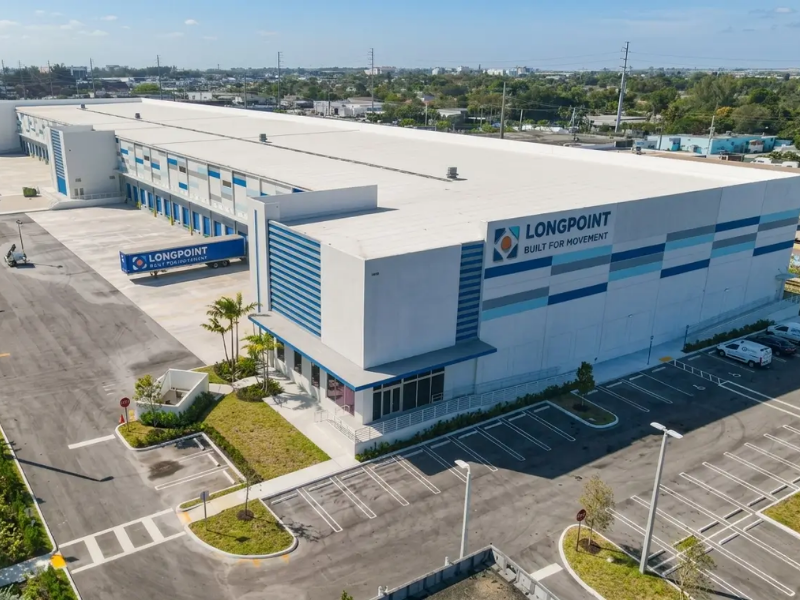
In the overall landscape of South Florida commercial real estate, few submarkets play as crucial a role in urban logistics as South Central Miami. This submarket is positioned between key east-west transport corridors and central residential density. Therefore, this infill submarket serves as a vital arterial zone for last-mile delivery. Moreover, it is key for regional distribution and trade services.
At the center of this submarket’s evolving ecosystem sits Point 27th. This is a functional industrial park that exemplifies how modern logistics infrastructure operates within a land-constrained urban environment.
This educational analysis examines Point 27th within the broader context of the South Central Miami industrial submarket. It evaluates its structural features and location advantages. In addition, it reviews market positioning amidst current regional supply and demand shifts in +/- 2026.
The South Central Miami submarket landscape
To understand Point 27th, one must first look at the unique micro-market factors shaping South Central Miami. Unlike suburban industrial nodes in West Miami-Dade that have historically expanded through new greenfield development, South Central Miami is an established infill zone. Additionally, it is characterised by tight spatial boundaries and high barriers to entry.
According to data available on Agora’s South Central Miami submarket overview, the submarket is defined by several core metrics:
- Total submarket inventory: Approximately +/- 18.2 million square feet of industrial space.
- Submarket vacancy rate: Maintained at a tight +/- 4.8% to +/- 5.5% range, consistently tracking below the county-wide average.
- Construction pipeline: Limited to +/- 0 square feet of speculative ground-up development due to the extreme scarcity of vacant land parcels.
- Average asking rent: Ranging between +/- $18.00 and +/- $21.00 per square foot NNN, depending on clear height, loading configurations, and building vintage.
Because ground-up development is virtually non-existent, industrial inventory in South Central Miami relies heavily on well-maintained multi-tenant parks. Occupiers in this submarket prioritise speed-to-market and proximity to dense consumer populations. Furthermore, they require rapid access to primary transport arteries.
Point 27th: Structural Profile & Operational Design
Point 27th stands out within South Central Miami as a functional industrial park designed to accommodate light manufacturing, trade services, and mid-tier logistics operations. Rather than catering exclusively to mega-distribution centres, Point 27th serves the high-demand segment of small-to-medium-sized industrial tenants. Notably, these tenants require versatile square footage.
Key building features
- Functional clear heights: Offering ceiling clear heights of +/- 20′ to +/- 24′, providing adequate vertical storage efficiency for local inventory management and warehousing.
- Loading configuration: Equipped with a mix of dock-high loading doors and drive-in ramps, accommodating both heavy commercial trucks and local delivery vans.
- Bay flexibility: Modular bay sizes ranging from +/- 5,000 to +/- 25,000 square feet, allowing tenants to adapt their footprint as operational needs evolve.
- Truck court depth: Features shared asphalt and concrete truck courts with depth allowances of +/- 100′ to +/- 120′, essential for daily staging and turning maneuvers.
By maintaining high structural functionality, Point 27th addresses a common challenge in mature infill submarkets: balancing site constraints with modern operational flow. Meanwhile, businesses evaluating available spaces can explore similar footprints through Agora’s commercial properties for lease.
Transit geometry & connectivity advantages
The primary value driver for Point 27th is its strategic positioning within South Central Miami’s transport grid. In modern logistics, “transit geometry”—the physical ease with which a vehicle exits a property onto primary roadways—directly impacts operational overhead. In addition, it affects delivery efficiency.
Strategic infrastructure connections
- Primary roadway access: Direct proximity to NW 27th Avenue, a major north-south commercial corridor providing seamless movement through central Miami-Dade.
- Expressway links: Rapid connection to SR 836 (Dolphin Expressway) and SR 112 (Airport Expressway), located within a +/- 5 to +/- 10 minute drive.
- Port & airport proximity: Positioned approximately +/- 6.5 miles from Miami International Airport (MIA) cargo gates and +/- 9.0 miles from PortMiami, placing it in a prime location for dual-access supply chains.
For last-mile distributors, this central node minimises “stem time”—the unproductive hours spent travelling from a warehouse to the first delivery stop. Operating out of Point 27th allows logistics providers to service key urban nodes like Downtown Miami, Coral Gables, Wynwood, and Hialeah. As a result, they enjoy reduced highway delay.
You might be interested in: What is a triple net (NNN) lease? Benefits, risks, and examples
Market positioning & economic analysis
From an investment and tenant retention perspective, properties like Point 27th represent stable, high-demand assets within the local real estate hierarchy.
Rent performance and triple-net (NNN) dynamics
Industrial lease structures in South Central Miami operate predominantly on a triple-Net basis. For a facility like Point 27th, financial mechanics reflect the infill premium:
- Base rent: Base rates generally trade within the +/- $18.50 to +/- $20.50 per square foot NNN range.
- Operating expenses (CAM): Real estate taxes, property insurance, and common area maintenance typically add an additional +/- $4.50 to +/- $6.00 per square foot.
- Tenant retention: Due to the severe lack of local inventory alternatives, tenant renewal rates across multi-tenant parks in South Central Miami remain high, averaging above +/- 80%.
While outer suburban parks offer taller clear heights (+/- 32′ to +/- 36′), they often require longer transit times to reach Miami’s core population centres. Point 27th highlights an essential market principle. That principle is that location efficiency frequently outweighs hyper-modern specs for local service and last-mile operators.
Practical considerations for industrial occupiers
When evaluating industrial space within Point 27th or surrounding infill blocks, asset managers and tenants should review several practical metrics:
- Power allocations: Verifying three-phase electrical capacity to support specialized equipment, assembly, or cold storage needs.
- Parking ratios: Assessing auto-to-square-foot parking ratios (+/- 1.5 to +/- 2.0 spaces per +/- 1,000 SF) to ensure employee parking does not encroach on loading zones.
- Expense verification: Reviewing historic NNN expense breakdowns to account for statewide insurance shifts across coastal Florida.
Frequently Asked Questions (FAQ)
What are the current rental rates in South Central Miami?
Average asking rents in South Central Miami range between +/- $18.00 and +/- $21.00 per square foot NNN. Operating expenses (CAM, taxes, and insurance) add an estimated +/- $4.50 to +/- $6.00 per square foot.
Why is there zero new industrial construction in South Central Miami?
South Central Miami is a fully built-out, mature infill submarket. Because vacant land parcels are virtually non-existent, new supply remains at +/- 0 square feet. As a result, this drives high competition for existing functional facilities like Point 27th.
What types of businesses thrive in Point 27th?
Point 27th caters primarily to light manufacturing, trade services, e-commerce fulfillment, building material suppliers, and regional HVAC/electrical distributors requiring flexible bay sizes from +/- 5,000 to +/- 25,000 square feet.
Strategic outlook
Point 27th serves as a benchmark for functional infill real estate in South Florida. It is located within a highly constrained submarket featuring a tight +/- 4.8% vacancy rate and zero incoming construction. Therefore, the park offers irreplaceable proximity. For example, it is close to Miami’s primary transit networks and commercial centres.
To stay informed on regional submarket shifts, explore our latest updates through Agora Real Estate Group market reports. Whether you are evaluating lease options or reviewing portfolio positioning, contact the advisory team at Agora Real Estate Group for specialized market guidance.