
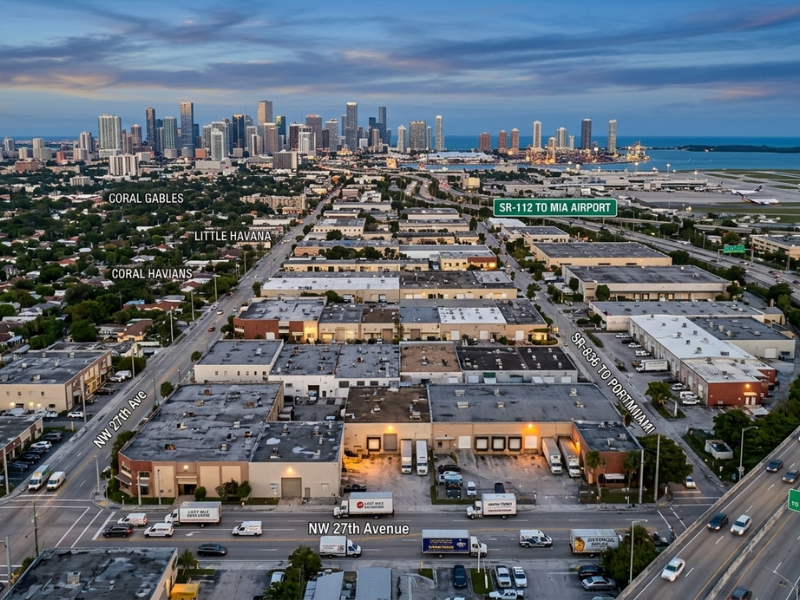
The commercial landscape across South Florida has experienced a profound shift toward urban infill positioning, elevating South Central Miami industrial real estate into one of the most resilient submarkets in Miami-Dade County. While peripheral submarkets such as Doral, Medley, Hialeah, and Opa-locka continue to accommodate large-scale distribution centers and cross-dock logistics facilities, South Central Miami fulfills a distinct operational role. Operating as a mature, densely populated arterial hub, this corridor provides vital last-mile delivery channels, light manufacturing centers, and service-trade facilities that sustain the broader South Florida economy.
As land constraints across Miami-Dade County reach historic highs, urban real estate assets in South Central Miami have become primary targets for capital preservation and long-term yield growth. This comprehensive guide examines the macro and microeconomic forces driving performance in South Central Miami, detailing operational metrics, core asset profiles, underwriting considerations, and strategic outlooks for commercial real estate professionals.
Strategic position & transit geometry
South Central Miami’s central location drives demand for last-mile industrial facilities. The submarket sits within Miami’s urban core. Unlike expanding suburban industrial markets in West Miami-Dade that historically grew through greenfield development, South Central Miami is an established infill submarket bounded by dense residential neighborhoods and major commercial corridors.
The submarket benefits from exceptional transit geometry, which refers to the physical ease with which commercial vehicles access primary arterial highways from local industrial parks. Situated within minutes of state routes SR-112 (Airport Expressway) and SR-836 (Dolphin Expressway), along with direct access to NW 27th Avenue and Interstate 95, facilities in South Central Miami offer seamless connectivity to Miami International Airport (MIA) and PortMiami.
For last-mile logistics operators and regional trade contractors, this positioning significantly reduces “stem time”—the unproductive commuting hours spent traveling between distribution centers and initial delivery points. Consequently, logistics providers are willing to pay a premium for location efficiency to meet strict same-day and next-day delivery SLAs across Downtown Miami, Brickell, Coral Gables, and surrounding metropolitan areas.
Key market metrics & infill real estate dynamics
To accurately evaluate investment and leasing opportunities, commercial real estate professionals must analyze the foundational performance indicators shaping Miami infill real estate.
The submarket encompasses a total inventory of approximately +/- 14.4 million square feet of industrial space. Unlike outer markets, where ongoing construction periodically increases local inventory, South Central Miami maintains an active speculative construction pipeline of +/- 0 square feet. This absolute lock on ground-up supply stems from parcel fragmentation, severe land scarcity, and elevated land costs trading between +/- $2.5 million and +/- $4.0 million per acre.
See more at Agora Real Estate Group’s submarket analysis,
Despite broader regional vacancy realignments across South Florida, vacancy rates in South Central Miami remain tight, holding within the +/- 4.8% to +/- 5.5% range. Average Triple-Net (NNN) base rents are +/- $30.33 per square foot, with premium small-bay flex configurations achieving higher rates based on clear height, loading setup, and interior buildout. Operating expenses, including property taxes, structural insurance, and Common Area Maintenance (CAM), add an additional +/- $4.50 to +/- $6.00 per square foot. Capitalization rates for stabilized assets in this submarket generally settle between +/- 5.50% and +/- 6.25%, reflecting strong capital preservation fundamentals.
Detailed historical trends and comparative regional metrics are regularly compiled within Agora Real Estate Group market reports.
Operational asset profiles in South Central Miami
Investors and corporate tenants evaluating South Central Miami commercial properties will encounter a diverse mix of functional asset categories designed to support varied commercial activities:
- Multi-tenant small-bay flex parks: Featuring unit footprints ranging from +/- 2,500 to +/- 10,000 square feet, these properties cater to local trade contractors, HVAC operators, electrical suppliers, and specialized light fabricators. They typically feature clear heights of +/- 18 to +/- 22 feet, combined street-level and dock-high loading configurations, and modest office allocations (+/- 10% to +/- 20%).
- Infill distribution & last-mile warehouses: Ranging from +/- 20,000 to +/- 80,000 square feet, these mid-tier distribution facilities serve third-party logistics (3PL) providers, e-commerce networks, and regional food and beverage distributors requiring rapid access to urban consumer centers.
- Covered land & adaptive reuse sites: Older industrial inventory featuring low coverage ratios or short-term leases. These properties present value-add opportunities for institutional and private investors looking to reconfigure legacy structures or adjust below-market rents upon lease expiration.
Business owners and tenants looking to secure operational footprints in this tightly held corridor can review available opportunities through Agora’s commercial properties for lease.
Financial mechanics, underwriting & submarket comparisons
When underwriting acquisitions or structuring long-term leases in South Central Miami, commercial investors and corporate tenants must evaluate specific financial mechanics unique to coastal infill real estate.
Primary among these considerations is the structure of Triple-Net (NNN) leases. Under a standard NNN arrangement, tenants assume responsibility for baseline rent while absorbing proportional costs for real estate taxes, property insurance, and common area maintenance. Over recent operational cycles, commercial property insurance premiums across South Florida have adjusted, making accurate CAM underwriting essential. Investors must carefully inspect historic expense statements and building windstorm protections to ensure long-term cost predictability for occupiers.
Furthermore, because ground-up development is virtually nonexistent in South Central Miami, many legacy multi-tenant parks contain in-place leases signed +/- 3 to +/- 5 years ago that sit below current market rates. Acquiring assets with short Weighted Average Lease Terms (WALT) allows landlords to execute a mark-to-market strategy upon renewal, resetting base rents to current prevailing rates.
When compared to neighboring submarkets like Doral or Medley, South Central Miami offers distinct advantages. While Doral commands higher average NNN asking rents due to its modern Class A inventory and corporate headquarters presence, and Medley provides larger manufacturing plots, South Central Miami delivers superior proximity to Miami’s core population centers. Submarkets like Opa-locka and Hialeah provide alternative infill options, but South Central Miami remains unmatched in its direct south-and-east transit connectivity to Downtown Miami and PortMiami.
We recommend that you see: Point 27th: South Central Miami Industrial Analysis
Frequently Asked Questions (FAQ)
What makes South Central Miami industrial real estate unique compared to peripheral submarkets?
South Central Miami is a fully built-out, land-constrained infill submarket situated in the geographic center of Miami-Dade County. Unlike peripheral markets like Medley or Doral that have space for speculative park expansions, South Central Miami has +/- 0 square feet of speculative pipeline, ensuring high barrier-to-entry dynamics and stable tenant retention.
What are the average rental rates and operating expenses for commercial properties in South Central Miami?
Average base rental rates for industrial space in South Central Miami are +/- $30.33 per square foot Triple-Net (NNN). Operating expenses (CAM), which encompass real estate taxes, insurance, and maintenance, typically range from +/- $4.50 to +/- $6.00 per square foot, depending on building age and property classification.
What types of businesses represent the primary tenant demand in this submarket?
Tenant demand in South Central Miami is highly diversified. Primary occupiers include last-mile e-commerce logistics providers, third-party logistics (3PL) operators, regional trade contractors (electrical, HVAC, plumbing), food and beverage distributors, automotive suppliers, and light manufacturing firms requiring quick access to Miami’s urban core.
Why is there zero speculative new construction in South Central Miami?
The absence of speculative ground-up construction is primarily due to severe spatial limitations and total urban land saturation. Parcels are heavily fragmented, and available commercial land trades at elevated values between +/- $2.5 million and +/- $4.0 million per acre, making ground-up industrial development financially unfeasible compared to acquiring and repositioning existing assets.
How does “stem time” impact leasing decisions for last-mile logistics tenants?
“Stem time” refers to the non-productive transit time drivers spend traveling from a warehouse to their first delivery destination. Located within minutes of major expressways (SR-112, SR-836, I-95) and dense residential neighborhoods like Brickell, Downtown Miami, and Coral Gables, South Central Miami minimizes stem time, significantly lowering fuel and labor overhead for distribution networks.
Professional real estate guidance
The long-term outlook for South Central Miami industrial real estate remains exceptionally strong. Rooted in permanent spatial constraints, excellent transit connectivity, and steady last-mile logistics demand, this submarket continues to provide long-term capital preservation for landlords and critical infrastructure for growing businesses.
Whether you are a landlord seeking to optimize property management and leasing strategies, an investor evaluating value-add acquisitions, or a business owner searching for functional warehouse space, localized market expertise is essential. To discuss custom market strategies or evaluate current property opportunities across South Florida, contact the advisory team at Agora Real Estate Group today.