
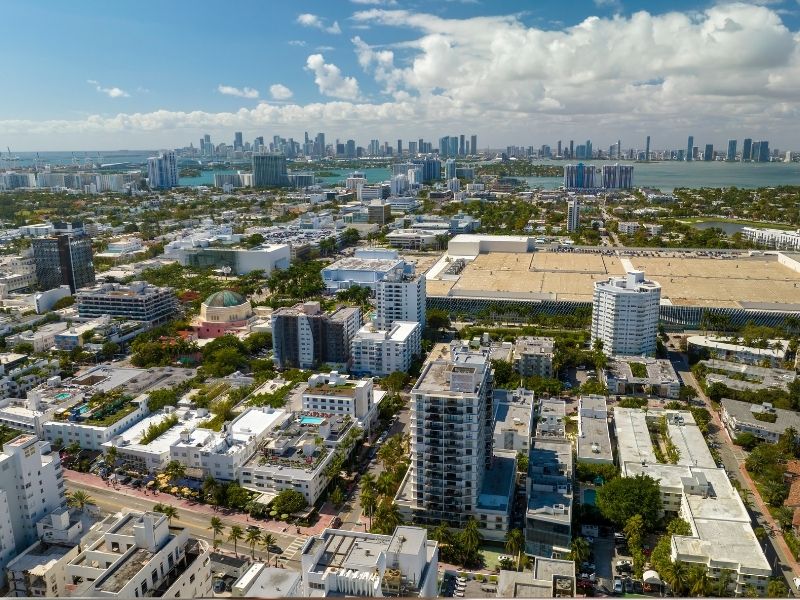
When analyzing industrial real estate in Miami-Dade County, most people naturally look toward the large logistics hubs in the western and northern parts of the metro. Neighborhoods like Doral, Medley, and Hialeah dominate the market because they house tens of millions of square feet of standard distribution space. However, there is a distinct, highly specialized segment of the industrial market located directly adjacent to the urban core. This is the East Miami industrial submarket.
Unlike the sprawling suburban logistics parks designed for heavy international freight management, East Miami functions as a compact, infill commercial corridor. It sits immediately near Downtown Miami, Brickell, and PortMiami. Because of this proximity, it serves a completely different purpose for businesses. Instead of bulk storage, it provides high-visibility spaces for companies that need immediate, daily access to the most densely populated and affluent parts of the city.
Market size and availability
To understand how this submarket operates, you have to look at its structural constraints. According to market data from Agora Real Estate Group, the East Miami industrial footprint consists of just 4.5 million square feet of total inventory. For comparison, neighboring industrial hubs like Miami Airport West and Medley industrial market hold over 64 million square feet, and Medley contains more than 41 million square feet.
This massive size difference shows that East Miami is a highly concentrated boutique market. Because the geographic area is fully urbanized and developed, there is no raw land available for new ground-up construction. Developers cannot simply buy a vacant lot and build a new warehouse park here. As a result, the supply of industrial and commercial space in East Miami is entirely fixed. Any company that wants to establish a presence in this location must compete directly for existing properties as they become available.
Analyzing the low vacancy rate
This absolute cap on new supply directly impacts availability. The current industrial vacancy rate in East Miami stands at 5.9%. What makes this figure notable is that it is actively decreasing. Across the broader Miami-Dade commercial real estate market in mid-2026, overall industrial vacancy has adjusted upward into a range of 6.5% to 7.7%. This countywide shift occurred because a significant volume of speculative, big-box warehouse completions delivered simultaneously, temporarily outpacing tenant leasing activity.
However, East Miami completely resists this broader regional trend. Its vacancy rate is going down rather than up. This divergence proves that the demand for urban infill locations remains intense. While larger corporations take more time to lease massive distribution centers in secondary or suburban locations, smaller service providers, showrooms, and last-mile distributors are actively absorbing any space that opens up near the urban core.
You might be interested in: Central Miami industrial real estate: Market strengths and key statistics
The reality of tenant leverage
A decreasing vacancy rate of 5.9% means that landlords hold almost all the leverage in negotiations. In a typical market with higher vacancies, tenants can ask for significant concessions, such as free rent periods or extensive tenant improvement allowances. In East Miami, those perks are rare.
Properties do not stay vacant for long periods. When a lease comes up for renewal or a space hits the market, multiple businesses are often ready to compete for it. For business owners, this means that lease underwriting must be precise, and decision-making timelines must be short. If you spend weeks hesitating on a property in this corridor, another business will likely secure it. This tight environment requires a highly proactive approach to property acquisition and renewal planning.
Premium rental rates
The combination of zero new development and falling vacancies has pushed the cost of space to record highs. Agora’s data shows that the average direct asking rent in East Miami has reached $29.25 per square foot on a triple net (NNN) basis. This metric is also on an upward trend.
To put this into perspective, the broader South Florida warehouse market averages between $16.00 and $20.00 per square foot NNN for premium Class A distribution space in suburban corridors. In secondary or older infill neighborhoods like Hialeah, average rents can sit closer to $11.00 to $14.00 per square foot. Paying nearly $30.00 per square foot for an industrial or flex asset represents a massive premium. Businesses accept this high cost because the location provides severe operational advantages that directly impact their bottom line, making the real estate expense a secondary concern.
Operational savings of infill locations
Why does a company agree to pay $29.25 per square foot NNN? It comes down to basic transportation math and service delivery efficiency. If a business operates a last-mile delivery service or a high-end contracting firm out of a cheaper warehouse in West Dade or Homestead, its vehicles must commute through heavy South Florida traffic daily.
Driving back and forth to service clients in Brickell, Downtown, or Miami Beach burns excessive fuel, adds wear to company vehicles, and wastes valuable technician hours. In mid-2026, labor and transportation costs remain major pressures for businesses. By paying a premium to locate in East Miami, a company can dramatically cut its drive times. A service vehicle can make multiple trips per day to urban clients instead of just one or two, heavily increasing revenue potential and offsetting the higher rent.
Rising purchase prices and investment values
This pricing pressure is equally visible in the investment and sales sector. The average market sale price for an industrial asset in East Miami has climbed to $381 per square foot, and like the rental rates, it continues to increase. This is among the highest asset pricing levels for industrial space in the region.
Investors are willing to pay these high valuations because the real estate is irreplaceable. In the broader mid-2026 capital markets environment, real estate buyers have become highly disciplined and selective due to persistent interest rates and tighter debt underwriting. However, urban infill properties with durable rental streams and zero risk of new supply competition are viewed as premier defensive assets.
Capital flows consistently to submarkets like East Miami because investors recognize that land constraints protect their asset valuations and support long-term rental income growth over time.
See more data on this submarket on our website.
The property profile: Office, showroom, and flex space
The physical layout of properties in East Miami differs significantly from traditional logistics warehouses. This submarket features a specialized mix of office, showroom, and urban industrial properties. Most of the buildings are multi-tenant facilities or small-bay warehouses under 50,000 square feet.
These properties are designed for businesses that require a diverse footprint. A high-end commercial tenant—such as an interior design group, an artistic manufacturer, a luxury auto specialist, or a boutique distributor—uses these buildings to combine multiple operations under one roof. The front section serves as a customer-facing showroom with premium visibility along major streets. The rear section functions as a functional warehouse for inventory storage, assembly, or dispatch. This dual-purpose configuration maximizes the utility of every square foot, justifying the high costs associated with the market.
Infill demand and small-bay undersupply
The intense demand for these dual-purpose layouts aligns with a broader structural trend across South Florida. Recent commercial real estate data from mid-2026 indicates that while large-scale, big-box warehouses over 100,000 square feet are experiencing longer lease-up times, small-bay and functional flex buildings remain severely supply-constrained.
Regionally, small-bay product commands a significant rent premium over bulk commodity space. East Miami represents the extreme end of this trend. The submarket’s properties support essential service companies—like commercial HVAC, electrical contractors, luxury catering companies, and event coordinators—that must maintain a physical base near the economic core of Miami. These occupiers cannot easily use remote or rural facilities because their business models rely entirely on rapid geographic responsiveness to the city center.
Strategic summary for businesses
In summary, the East Miami industrial submarket stands out as a unique, high-barrier-to-entry corridor within the South Florida real estate market. Its limited size of 4.5 million square feet guarantees that space will always remain at a premium. With an average rent of $29.25 per square foot NNN, a market sale price of $381 per square foot, and a declining vacancy rate of 5.9%, the data reveals a submarket driven by structural scarcity and exceptional geographic value.
For businesses and investors operating in mid-2026, navigating this tight environment requires immediate action and precise financial planning. Trying to wait out the market for lower rates is a flawed strategy in an area where demand consistently outpaces supply. Success in East Miami relies on recognizing the operational value of proximity and securing spaces efficiently before a lack of inventory eliminates options entirely.
Find more up-to-date industrial real estate trends at agorare.com